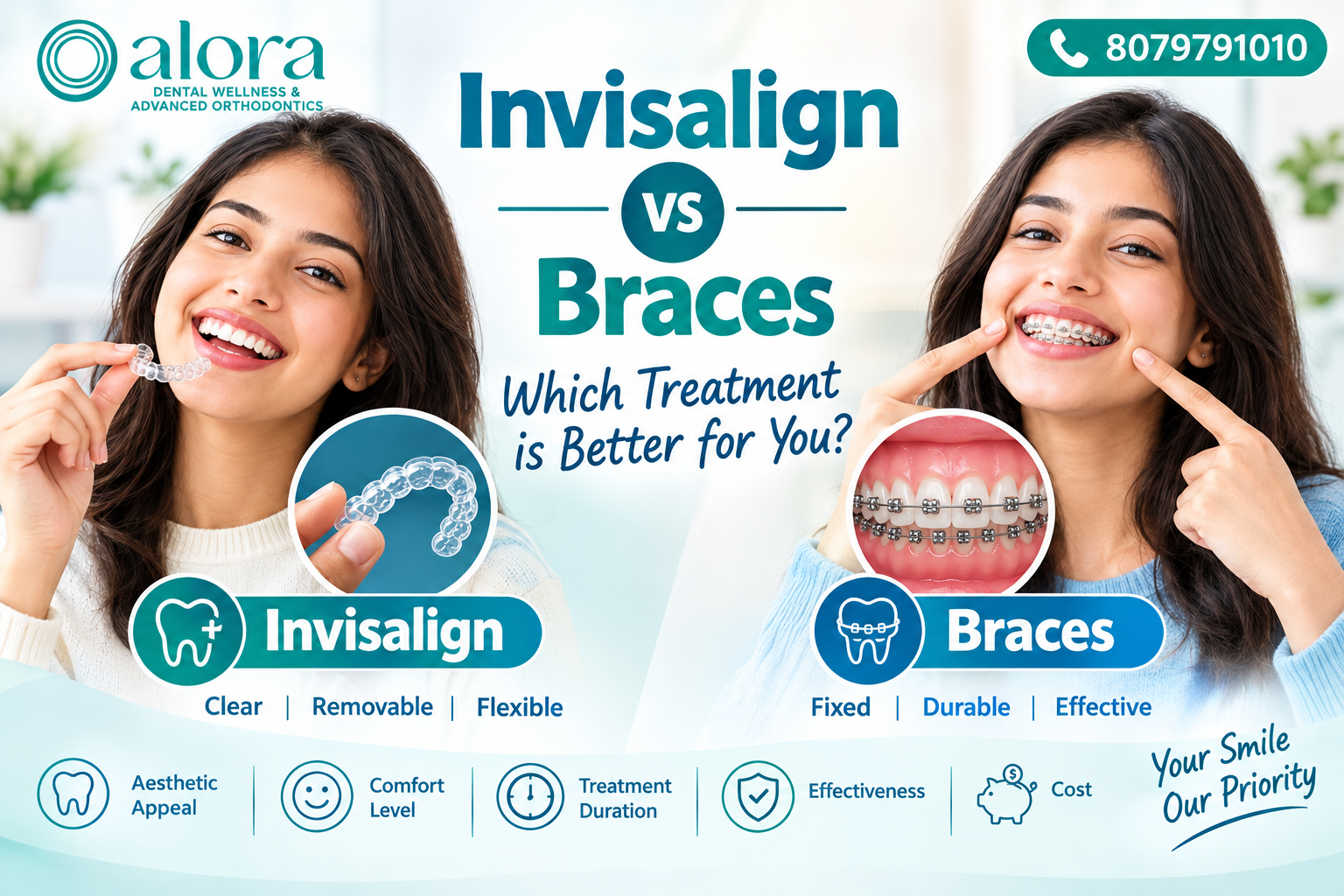
Having straighter teeth can not only enhance one’s looks but also assist in brushing and flossing better because proper alignment of teeth supports better bite function and contributes to long-term oral health. If you are considering orthodontic treatment, two popular choices are Invisalign and traditional braces. But which one is better for you?
The answer depends on several factors, including your dental condition, treatment goals, lifestyle, age, commitment, and the type of tooth movement required. At Alora Dental Wellness and Advanced Orthodontics in Bangalore, both clear aligners and different types of braces can be considered according to individual orthodontic needs.
What Is Invisalign?
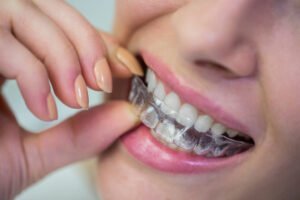
Invisalign is an advanced orthodontic technique that involves a set of customised, transparent aligners to move teeth into planned positions gradually. Unlike traditional braces, Invisalign does not use metal brackets and wires. The aligners are designed using digital treatment planning and can be easily taken out during meals and teeth brushing.
For effective treatment, patients generally need to wear their aligners for around 20–22 hours per day, removing them mainly for meals, drinking anything other than water, brushing, and flossing. Each set is replaced according to the treatment plan provided by the dental professional.
Invisalign may be used for several orthodontic concerns, including crowded teeth, gaps, crooked teeth, and certain bite issues like overbite, underbite, and crossbite. However, suitability depends on the complexity of each case.
What Are Traditional Braces?
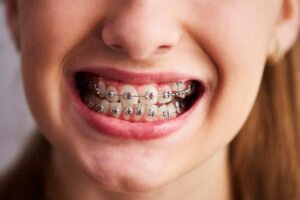
The traditional brace method involves fixing brackets and wires that exert controlled forces on the teeth. As time goes by, the orthodontist adjusts the device to ensure that the teeth align correctly.
Braces can be used as a dependable solution for numerous orthodontic issues. At Alora Dental Wellness, some of the options available are metal braces, ceramic braces, self-ligating braces, Damon braces, and Pitts 21 braces, based on the specific needs of the patient.
Due to the fact that braces are fixed on the teeth, the patient does not have to remember to wear them. This can be particularly helpful for people who may find it difficult to maintain the daily wear schedule required with removable aligners.
Invisalign vs Braces: Key Differences
1. Appearance
One of the biggest differences is visibility. Invisalign braces are clear and not detected while they are worn. This makes it a preferable option for people in a number of age categories, including adults, professionals, students, and young adults.
Metal braces are very visible due to their brackets and wires. Ceramic braces can be less conspicuous since their brackets are camouflaged with the teeth.
Winner for appearance: Invisalign
2. Removability
Invisalign trays can be taken off while eating, brushing and flossing. Thus, making it easier for individuals to continue with their regular oral hygiene practices.
Braces are fixed throughout treatment. Food can become trapped around brackets and wires, so careful brushing and flossing are especially important.
Winner for flexibility: Invisalign
3. Eating and Food Choices
By removing the aligners before eating, patients become more flexible in choosing their food intake. After eating, teeth should be cleaned before the aligners are replaced again.
With traditional braces, certain hard, sticky, or chewy foods may need to be avoided because they can damage brackets or wires.
Winner for eating convenience: Invisalign
4. Oral Hygiene
Maintaining excellent oral hygiene is important during any orthodontic treatment.
Invisalign can make brushing and flossing more convenient because the aligners are removable. Patients can clean their teeth normally before putting the aligners back in.
Braces require additional care because brackets and wires remain attached to the teeth. Special brushing and flossing techniques may be recommended to clean around the orthodontic appliances.
Winner for ease of cleaning: Invisalign
5. Discipline and Compliance
This is where braces can have an advantage.
Because braces are fixed, they remain in place throughout treatment. Invisalign requires consistent patient cooperation. If aligners are not worn for the recommended amount of time, treatment may not progress as planned. For patients who are disciplined about wearing their aligners for approximately 20–22 hours a day, Invisalign can be a convenient option.
Winner for patients who prefer a fixed appliance: Braces
6. Complex Orthodontic Problems
There are orthodontic cases. Some patients will have fewer problems when it comes to the alignment of their teeth. In contrast, others will have more complicated cases that require complex movement of their teeth and comprehensive orthodontic therapy.
Clear aligners can address many alignment and bite concerns, but braces may be recommended for certain complex cases depending on the patient’s teeth, bite, bone structure, and treatment objectives.
Therefore, the most advanced-looking treatment is not automatically the best treatment. A professional orthodontic assessment is essential before making a decision.
Winner: Depends on your individual case
Invisalign or Braces: Which Is More Comfortable?
Comfort can vary from person to person. Invisalign aligners are made from smooth plastic and do not use conventional metal brackets and wires. Many patients appreciate the reduced irritation associated with a removable, smooth appliance.
Braces may cause temporary soreness or irritation, particularly after placement or adjustments. This generally improves as the mouth adapts to the appliance.
Your orthodontist can explain what to expect based on the treatment recommended for you.
How Long Does Treatment Take?
The time frame for treatment greatly depends on how complex the case is, the amount of tooth movement required, and patient compliance.
Alora Dental Wellness notes that Invisalign treatment may take approximately 6 to 18 months in many cases, although individual treatment time can differ. Traditional braces commonly require around 12 to 24 months, but the actual duration depends on the patient’s orthodontic needs and response to treatment.
A consultation is the best way to receive an individualised treatment timeline.
Which Treatment Is Better for Adults?
Both options can be suitable for adults. Many adults prefer Invisalign because the aligners are discreet and removable. This can make orthodontic treatment easier to integrate into professional and social situations.
However, adults who require more complex orthodontic treatment may benefit from braces or an extensive orthodontic program. Alora Dental Wellness provides both clear aligners and traditional orthodontic options for adults.
Which Treatment Is Better for Teenagers?
Teenagers can also benefit from either Invisalign or braces, depending on their dental needs and ability to follow treatment instructions.
Invisalign can offer advantages for teenagers involved in sports, playing musical instruments, or those concerned about the appearance of traditional braces. However, consistent aligner wear is essential.
For teenagers who may frequently forget or remove their aligners, fixed braces may provide a more predictable option because the appliance stays in place.
Invisalign vs Braces: A Simple Comparison
Feature | Invisalign | Traditional Braces |
|---|---|---|
Appearance | Nearly invisible | More noticeable |
Removable | Yes | No |
Eating flexibility | High | Some restrictions |
Oral hygiene | Easier | Requires extra care |
Daily responsibility | High | Lower |
Visible wires/brackets | No | Yes |
Suitable for adults | Yes | Yes |
Suitable for teenagers | Yes | Yes |
Complex cases | Case-dependent | Often useful |
Follow-up | Based on treatment plan | Usually regular adjustments |
So, Which Treatment Is Better for You?
There is no universal winner between Invisalign and braces.
Invisalign may be a good choice if you:
- Want a discreet orthodontic treatment
- Prefer removable aligners
- Want greater flexibility while eating
- Want easier access for brushing and flossing
- Can consistently wear your aligners as instructed
Braces may be a better option if you:
- Need treatment for a more complex orthodontic problem
- Prefer a fixed appliance
- May struggle to wear removable aligners consistently
- Want an established orthodontic option with different appliance choices
Ultimately, the right treatment should be selected based on your teeth, bite, oral health, lifestyle, and orthodontic goals—not simply on appearance.
Get Personalised Orthodontic Guidance in Bangalore
If you are unsure whether Invisalign or braces are right for you, a professional consultation can help you understand your options. At Alora Dental Wellness and Advanced Orthodontics in Bangalore, patients can discuss their smile concerns and receive a treatment approach based on their individual orthodontic requirements. The clinic provides clear aligners as well as multiple braces options, with treatment planning supported by modern dental technology.
Dr Apoorva Gopi is an orthodontist and cosmetic dentist at Alora Dental Wellness, with experience in aligners and orthodontic systems; the clinic also identifies her as a certified Invisalign specialist.
If you are considering Invisalign in Bangalore or braces in Bangalore, schedule a consultation to determine which approach is appropriate for your smile.